

Child Support Reduction: When Can Payments Be Changed and What Are the Main Grounds?
Family law|March 31, 2026

LawReviews
LawReviews
Child support reduction is possible when a material change in circumstances has occurred since the court ruling or agreement was approved. Common grounds include a significant change in custody time, a substantial and ongoing decrease in income, or a material change in the child's needs. In most cases, a dispute resolution request must first be filed, and the claim must be supported by evidence, financial documents, and full disclosure.
Table of Contents:
- Increasing / Reducing Child Support
- Child Support Reduction Due to Material Change in Circumstances
- What Constitutes a Material Change in Circumstances?
- Child Support Reduction Due to Parental Alienation
- Child Support Reduction After Remarriage
- Retroactive Child Support Reduction
- Request for Child Support Reduction and the Child's Best Interests
- The Importance of Family Law Attorney Guidance
Determining child support payments is part of the divorce process for every couple with children. The amount of spousal and child support is set during the proceedings — either through a divorce agreement or by court ruling — based on the law and the couple's specific life circumstances. However, life is dynamic, and events or changes in either party's life sometimes create a shift in financial circumstances that makes it impossible for the paying parent to meet their obligations.
This is why it is possible to request or demand a reduction in child support payments — but it is important to know that such reductions are not granted easily (particularly not by the court), and certain conditions must be met.
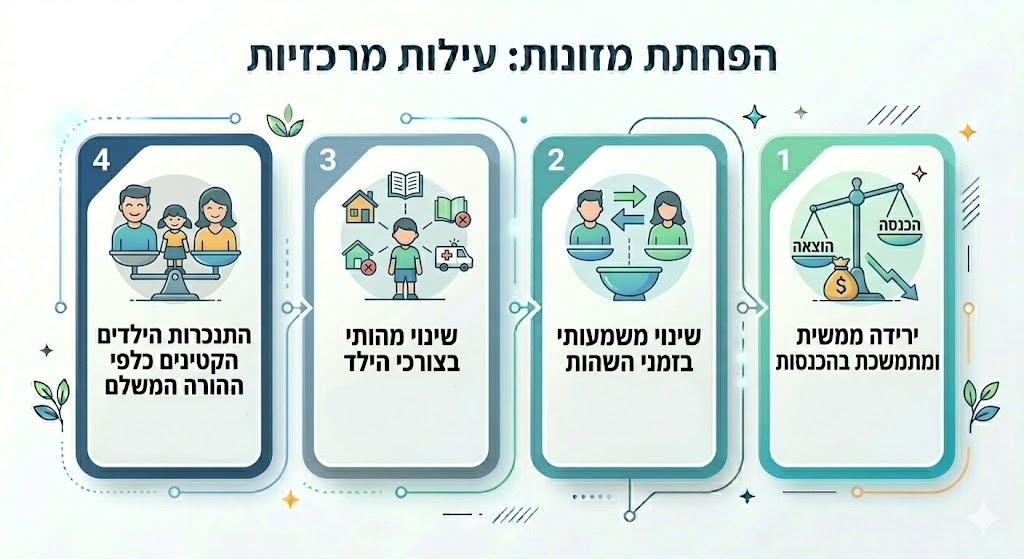
Increasing / Reducing Child Support
Child support is determined by a court ruling or a divorce agreement that has been granted the force of a court ruling. It is important to distinguish between two tracks for changing the amount: the first is an appeal against the ruling, filed shortly after it is issued within the legally prescribed timeframe. The second track, unique to family support matters, is a claim to modify the support amount (increase or decrease). Since a child support ruling is not considered fully "final," it is possible to file for a change in terms even after the appeal period has ended, provided that a "material change in circumstances" has occurred that justifies it. This means the amount can be requested to be changed at any time if justified circumstances exist.
If a parent wishes to reduce or increase child support for their child, they can do so either through dialogue and agreement with the other party, or by filing a claim in court.
A claim to reduce or increase child support will be accepted in cases where the support amount was determined without properly examining the child's needs, or where a material change in circumstances occurred after the ruling was issued or the divorce agreement was approved.
Child Support Reduction Due to Material Change in Circumstances
When a paying parent seeks to reduce child support, they must prove a material change in circumstances that prevents them from paying the required amount. A child support debt holds priority status, and the principle is that the children's welfare comes before the parent's debts. Therefore, courts do not easily accept requests for reduction — only when it is proven that circumstances have changed in a way that genuinely prevents continued payment of the obligated amount.
A claim for reduction may be accepted, for example, when there is a material change in circumstances meaning a significant deterioration in the earnings or earning capacity of the paying parent (usually the father). This includes, among other things, disability or illness, business failure, termination in certain cases, and more.
As part of the claim, the paying parent must prove the change in circumstances and meet three conditions for the court to rule that a change in support is justified:
- A very significant change in life circumstances has occurred (supported by solid evidence).
- The change occurred after the divorce agreement was approved and could not have been anticipated in advance.
- Leaving the situation as-is would cause injustice to one of the parties.
Ultimately, a material change in circumstances is a change that was not foreseeable at the time the agreement was signed or the ruling was issued, and where maintaining the status quo would be unjust.
What Constitutes a Material Change in Circumstances?
A change in the father's financial situation can arise from various events such as illness, impaired earning capacity, or loss of income — but each case is examined on its own merits. For example, a person who has become ill or disabled due to an accident, and can no longer work or earn the same amounts as before — this constitutes a material change in circumstances.
By contrast, a person who has been dismissed from their job does not necessarily have an impaired earning capacity, as they may be able to find new employment. However, in certain cases — such as an older worker who has been laid off — their earning capacity may genuinely be affected due to difficulty finding new employment, and as such, their argument of a material change in circumstances may be accepted.
Child Support Reduction Due to Parental Alienation
It is important to note that loss of income is not the only ground for reducing child support. In cases of minor children becoming estranged from the paying parent, the court may order a reduction in support. When the court declares children to be "contact refusers" with the paying parent, it can order a reduction in the support amount set by the agreement — and in exceptional cases, even cancel the support payments entirely.
Child Support Reduction After Remarriage / Starting a New Family
In many cases, divorced parents start new families and must manage financing a new family alongside paying child support. Even though this is a change that could not have been anticipated at the time of divorce, and even though having additional children affects the paying parent's financial capacity, it has generally been determined that this does not constitute a material change in circumstances that justifies a reduction. Parents should be aware that they are obligated to provide for all of their children.
Retroactive Child Support Reduction
Supreme Court rulings clarify that support agreements are not easily reopened. To change an amount determined in the past, one must prove a material and personal change in circumstances that has occurred since the agreement was approved. For anyone seeking to reduce support (including retroactively), this means that relying on "new precedents" or general changes in the law is insufficient; the court requires factual evidence of the new situation, and only a significant and documented change will justify intervening in the previously determined amount.
Request for Child Support Reduction and the Child's Best Interests
It is always possible to request a change in the support amount. This reflects the reality that everyone's life is complex and subject to change — changes that in some cases affect the entire family, which is why they are called a material change in circumstances. At the same time, it is always important to remember that child support is designed to support the needs and upbringing of our children. It is not a punishment or a fine, but rather an obligation (and also a right) that we carry.
The Importance of Family Law Attorney Guidance
The process of reducing child support is one of the most complex in family law, as it requires "breaking open" an existing ruling. An experienced family law attorney plays a critical role from the preliminary stage: they assess whether the change in circumstances actually meets the high evidentiary threshold required by the court, thereby preventing the filing of frivolous claims that may result in significant cost orders. Professional guidance from a qualified and experienced attorney enables the development of the right legal strategy — from drafting the dispute resolution request, through meticulous collection of financial documents, to representation before the various courts. It is important to emphasize that errors in managing the process or incomplete presentation of data can lead to the claim being dismissed and block the possibility of refiling for the near future.
Articles in Family law

Wife's Alimony: The Complete Guide — How Is the Amount Calculated and Who Is Entitled?
Everything you need to know about wife's alimony: who is entitled to receive it, how the amount is calculated, when entitlement ends, and what the obligations of each party are in the divorce process. The professional guide by LawReviews.
LawReviews

Common-Law Partners — The Complete Guide: All the Rights, Obligations and Risks You Should Know
Learn about the rights, obligations and risks of common-law partners. Information on proving status, financial rights, financial agreements, and property division under the presumption of sharing upon separation.
LawReviews

Until What Age Is Child Support Paid
Until what age is child support paid? All the information on child support payments up to age 6 and up to age 18. What does the law stipulate for exceptional cases and for adult children.
LawReviews

Child Support – How Is It Calculated According to Court Rulings?
A comprehensive and up-to-date guide to child support in Israel: how the amount is calculated, the impact of custody arrangements, and sanctions for non-payment
LawReviews

Divorce by Mutual Consent: Process, Pros and Cons, Costs and Legal Aspects
A legal overview of divorce by mutual consent: the dispute resolution process, advantages, disadvantages, costs, and everything you need to know before signing a divorce agreement and submitting it for court approval.
LawReviews

Child Support – How Is It Calculated According to Court Rulings?
A comprehensive and up-to-date guide to child support in Israel: how the amount is calculated, the impact of custody arrangements, and sanctions for non-payment
LawReviews
Book an Appointment
The service provided through the website is not a legal service. Documentation and sensitive information should only be given to lawyers.
About LawReviews
LawReviews is the most advanced and trusted lawyer directory in Israel, centralizing information and verified reviews on law firms. The platform, part of Israel's leading review sites group, connects clients seeking quality legal representation with recommended and top attorneys. We do this through rigorous verification technology ("wisdom of the crowd") and advanced filtering mechanisms, providing full transparency in the legal world and enabling informed decision-making.
Navigation
Contact UsAbout UsPrivacy PolicyTerms of UseAccessibility StatementLegal GuidesPhoto GalleryCreate a Lawyer ProfileLogin to Personal AreaPopular Practice Areas
Criminal LawyerEmployment LawyerFamily LawyerTraffic LawyerMedical Malpractice AttorneyNational Insurance LawyerReal Estate LawyerDebt Enforcement AttorneyTort LawyerInsolvency AttorneyWills & Inheritance LawyerCommercial LawyerDisclaimer
The information and content displayed on this site is intended to provide informative information and expressive opinion on behalf of third parties only they are not a substitute for professional legal advice and should not be relied upon as such advice. Any use of the information on the site requires examination and verification with the relevant parties. Use of the site and its contents is the sole and complete responsibility of the user
Popular Searches
DivorceTraffic AccidentsWork AccidentsPersonal InjuryPrenuptial AgreementApartment SaleApartment PurchaseDrunk DrivingSexual HarassmentWeapons License