

Driving Under the Influence of Drugs: What Does the Law Stipulate and What is the Punishment?
Traffic law|May 24, 2026

LawReviews
LawReviews
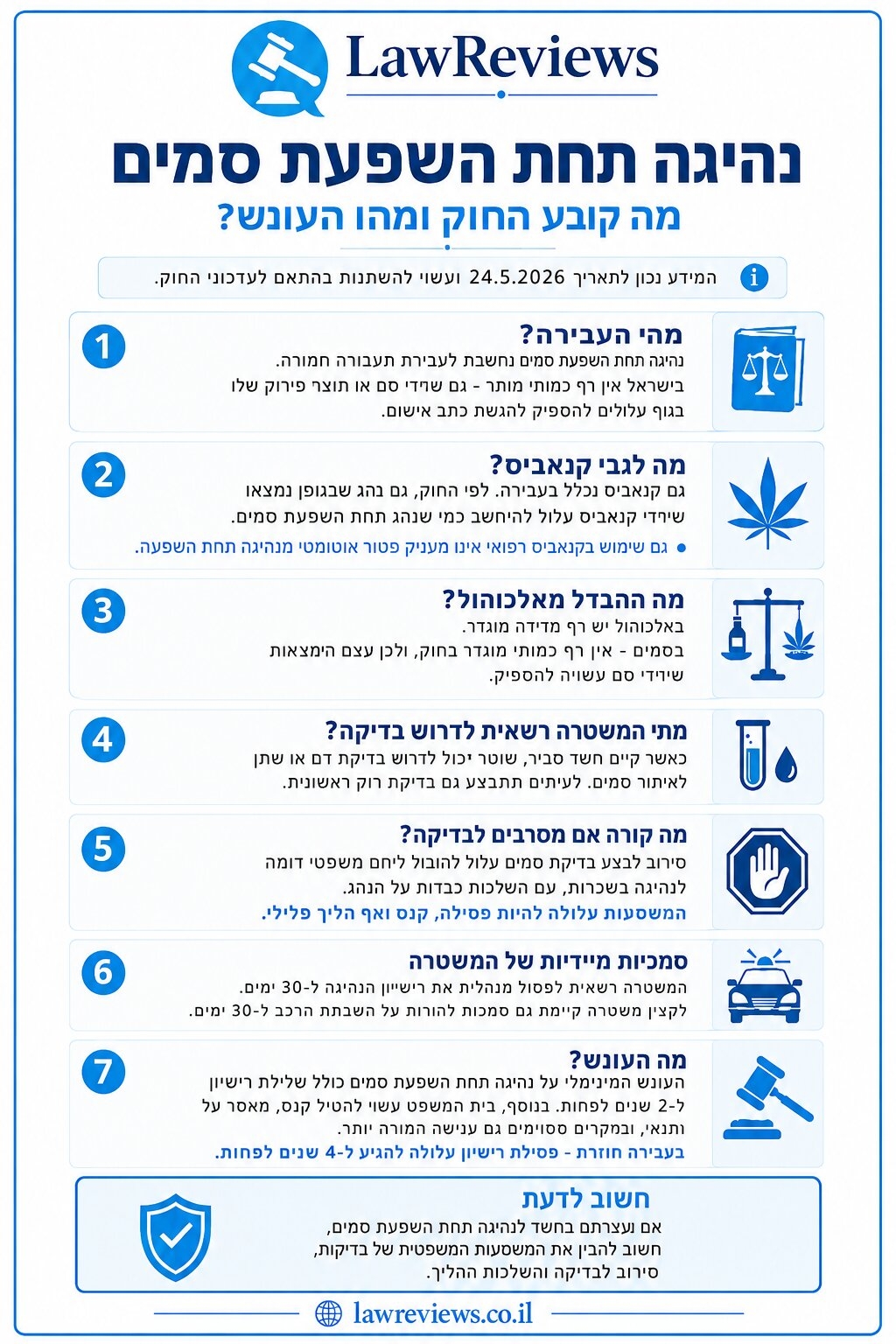
Driving under the influence of drugs is considered one of the most severe traffic violations, and the law applies a strict and uncompromising policy toward it. Unlike driving under the influence of alcohol, where a defined numerical threshold separates the permitted from the prohibited, in the context of drugs there is an absolute ban on any amount whatsoever (drug traces). This means that the presence of any quantity of a drug in a blood or urine test, or of its metabolites, is sufficient to define the trip as driving under the influence and lead to harsh penalties.
Table of Contents:
- What is driving under the influence of drugs?
- Driving under the influence of cannabis
- What is the difference between driving under the influence of drugs and drunk driving?
- When is a police officer authorized to demand a drug test from a driver?
- Drug testing of drivers by the police
- What happens if a driver refuses to undergo a drug test?
- Are drug traces in the body sufficient for filing an indictment?
- Driving under the influence of drugs – punishment
- When should you consult a criminal lawyer specializing in traffic law?
Driving under the influence of drugs, much like driving under the influence of alcohol, is considered a very severe offense that carries heavy penalties such as fines, license revocation, and in certain cases, actual imprisonment. Road accident data in Israel indicate that driving under the influence of drugs/alcohol is a significant cause of accidents, road fatalities, and injuries. In fact, an average of over 300 people are injured every year in road accidents related to drugs or alcohol. Although the state attempts to combat the phenomenon, no improvement is yet visible.
What is driving under the influence of drugs?
Driving under the influence of drugs is a criminal traffic offense that poses a danger to both the driver themselves and other road users. Due to the high potential for harm, when a police officer has a reasonable suspicion that a specific driver is driving under the influence of drugs, they have the authority to demand that the driver undergo a laboratory test (blood or urine) to detect the drugs. Furthermore, a police officer has the authority, even without reasonable suspicion, to ask any driver to undergo a breathalyzer test to detect alcohol or an initial saliva test to detect drugs. Refusing to undergo the tests establishes a legal presumption against the driver that they were driving while intoxicated, and they will be charged and tried as a drunk driver.
Anyone caught driving under the influence of drugs/alcohol faces severe penalties such as a minimum license disqualification for two years, monetary fines, and in some cases, actual imprisonment and a suspended sentence. Sometimes, the defendant will be referred for a reassessment regarding their fitness as a driver.
Driving under the influence of cannabis
According to Israeli law, driving under the influence of drugs/alcohol is considered as such if drug traces or its metabolites are found in the driver's body, even if they consumed the drugs a long time before driving. This also applies to cannabis. According to studies, the active ingredient in cannabis (THC) affects the brain and concentration, such that reaction speed slows down, coordination is impaired, and space and time perception are disrupted. Therefore, anyone caught driving under the influence of cannabis faces severe penalties.
As for patients holding a legal medical cannabis license, the law also prohibits them from driving under the influence of the drug and does not differentiate between the medical use of cannabis and any other use. However, in recent years, guidelines have been established allowing driving, provided that a defined time window has passed from the moment of consumption, they are not under active influence, and the amount in their body does not exceed the threshold permitted for patients.
What is the difference between driving under the influence of drugs and drunk driving?
The Israeli law differentiates between drunk driving and driving under the influence (drugs/alcohol). The fundamental difference between the two lies in the type of evidence held by the prosecution and the ability to prove the offense in a laboratory. If a driver is found in an objective test to have taken drugs or consumed alcohol, they are legally considered to have driven while intoxicated. However, intoxication cannot always be proven. Sometimes, the tests are conducted hours after the offense was committed, making it difficult to detect alcohol remnants. In these cases, the state relies on the driver's behavior (smell of alcohol, performance tests, etc.), and the offense attributed to the driver will be driving under the influence.
Because a drunk driving offense is considered more severe, the punishment for its conviction is also heavier. Anyone convicted of drunk driving will have their driver's license revoked in practice for at least two years and also faces a fine and a suspended sentence. A driver convicted of driving under the influence faces lighter punishment, such as a disqualification for three months only, but this also depends on the circumstances of the case, such as whether they were previously convicted of similar offenses.
When is a police officer authorized to demand a drug test from a driver?
The state treats the offense of driving under the influence of drugs with great severity. The potential for harm to the driver and the environment is what makes this offense one of the most severe in traffic law. This is also the reason why a police officer is permitted to ask a driver to undergo a blood or urine test to detect drugs if there is a reasonable suspicion that the driver is under the influence of drugs.
Drug testing of drivers by the police
Police officers can ask drivers, regarding whom a reasonable suspicion exists of being under the influence of drugs, to undergo a urine test or a blood test to detect drugs. The tests identify drug traces, and the identification does not always correspond to the degree of actual impairment. In drug tests conducted on drivers by the police, there is no numerical threshold defined in the law because it is difficult to measure the ratio between the drug trace and its practical, real-world impact.
What happens if a driver refuses to undergo a drug test?
When a driver refuses to undergo a drug test (blood or urine) at the officer's demand, even if there is a reasonable suspicion of driving under the influence of drugs, this carries severe legal consequences identical to a conviction for drunk driving. A driver who refuses a test will automatically be deemed to have driven while intoxicated, and is therefore subject to the revocation of their driver's license for at least two years, imprisonment, and an administrative disqualification.
Can the police disable or confiscate the vehicle?
According to the Traffic Ordinance, a police officer has the authority to order an administrative impoundment of the vehicle in which the offense was committed for 30 days, even if an indictment has not yet been filed. Concurrently, the police also have the authority to suspend the driver's license of the driver for 30 days immediately.
Are drug traces in the body sufficient for filing an indictment?
Drug traces in blood or urine tests are sufficient for filing an indictment for the offense of driving under the influence of drugs, even if the driver shows no behavioral signs indicating drug use, and even if very small remnants are found. Meaning, if a driver took the test a few days after consuming the drug, the test might still locate its traces, and they may stand trial for it.
Driving under the influence of drugs – punishment
Driving under the influence of drugs is considered a severe offense, and therefore the punishment is correspondingly heavy. In addition to an administrative disqualification of the driver's license for 30 days, the minimum sentence for driving under the influence of drugs includes a license revocation for at least two years. Alongside the mandatory disqualification, the court is authorized to impose a suspended sentence and a monetary fine on the driver. A driver convicted for the second time of this offense could face a driver's license disqualification for at least 4 years.
When should you consult a criminal lawyer specializing in traffic law?
Driving under the influence of drugs and, of course, driving under the influence of alcohol are severe, criminal traffic violations. Anyone convicted by law will find themselves without a driver's license for a prolonged period and may even lose their liberty. This is the reason why the moment you are arrested on suspicion of committing these offenses, it is advisable to contact a criminal lawyer specializing in traffic law.
An experienced criminal lawyer specializing in traffic law is someone practiced in representing drivers who committed these offenses, and they understand the nuances of the law, the changes occurring in it from time to time, and the way to achieve the best result. In certain cases, especially if evidentiary difficulties exist, an experienced lawyer specializing in drug offenses can alter the offense section from "drunk driving" to "driving under the influence," a change that may lead to a reduction in the sentence imposed upon you.
Summary
Articles in Driving under the influence of drugs

How Many Points Lead to a License Suspension: Point Steps and Driver's License Suspension
How many points lead to a license suspension in Israel? A short and clear guide on accumulating traffic points, proper driving courses, license disqualification, theory, practical test, and MARVAD.
LawReviews

How to Choose a Traffic Lawyer
A comprehensive guide to choosing a traffic lawyer: what to check, how to handle drunk driving, speeding, and road accident cases, and how to protect your driver's license.
LawReviews

Driver's License Revocation – How Long, What It Means, and Can It Be Shortened?
Everything you need to know about driver's license revocation in Israel: types of revocation, duration, what is prohibited during the revocation period, and how it can be shortened with the help of a traffic lawyer.
LawReviews

When Are Traffic Points Deleted
Accumulated points? Find out when traffic points are deleted, the difference between 2 and 4 years of accumulation, how to request deletion, and how a driving course affects validity. All questions and answers.
LawReviews

How Many Points Lead to a Preventive Driving Course
When are drivers sent to a preventive driving course, how many points obligate a basic or advanced course, and what should be checked to avoid severe sanctions by the Licensing Authority.
LawReviews

Application to Cancel a Criminal Record
How do you apply to cancel a criminal or police record? Who to apply to, the difference between the types of record, which documents to attach and what affects the application's chances.
LawReviews
Book an Appointment
The service provided through the website is not a legal service. Documentation and sensitive information should only be given to lawyers.
About LawReviews
LawReviews is the most advanced and trusted lawyer directory in Israel, centralizing information and verified reviews on law firms. The platform, part of Israel's leading review sites group, connects clients seeking quality legal representation with recommended and top attorneys. We do this through rigorous verification technology ("wisdom of the crowd") and advanced filtering mechanisms, providing full transparency in the legal world and enabling informed decision-making.
Navigation
Contact UsAbout UsPrivacy PolicyTerms of UseAccessibility StatementLegal GuidesPhoto GalleryCreate a Lawyer ProfileLogin to Personal AreaPopular Practice Areas
Criminal LawyerEmployment LawyerFamily LawyerTraffic LawyerMedical Malpractice AttorneyNational Insurance LawyerReal Estate LawyerDebt Enforcement AttorneyTort LawyerInsolvency AttorneyWills & Inheritance LawyerCommercial LawyerDisclaimer
The information and content displayed on this site is intended to provide informative information and expressive opinion on behalf of third parties only they are not a substitute for professional legal advice and should not be relied upon as such advice. Any use of the information on the site requires examination and verification with the relevant parties. Use of the site and its contents is the sole and complete responsibility of the user
Popular Searches
DivorceTraffic AccidentsWork AccidentsPersonal InjuryPrenuptial AgreementApartment SaleApartment PurchaseDrunk DrivingSexual HarassmentWeapons License