

Continuing Power of Attorney: The Complete Guide
Family law|July 17, 2026

LawReviews
LawReviews
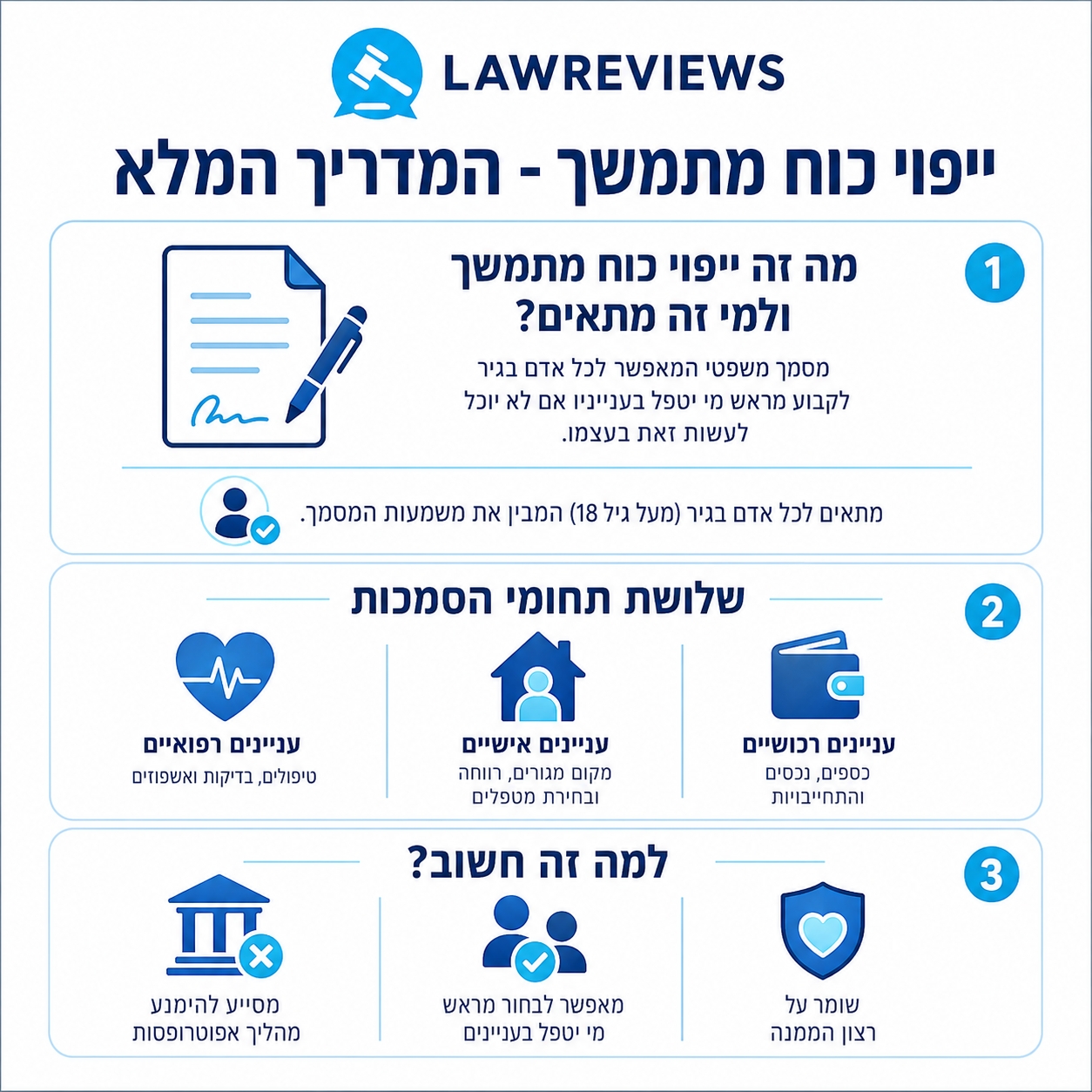
A continuing power of attorney is a legal document that allows any adult aged 18 or over to decide in advance who will be authorized to make decisions and act on their behalf in the future, should they no longer be able to understand or manage their own affairs. The document can authorize the attorney-in-fact to handle property, personal and medical matters, in line with the wishes, needs and instructions the grantor set out in advance.
The continuing power of attorney came into force in Israel in 2017 following Amendment 18 to the Legal Capacity and Guardianship Law. Since then, the number of people signing the document has grown steadily. According to Ministry of Justice data, 562 people signed a continuing power of attorney in 2017, 27,292 in 2020, and more than 50,000 in 2025.
Table of contents:
-
When should you make a continuing power of attorney, and who is it for?
-
What powers and instructions can a continuing power of attorney include?
-
Continuing power of attorney between spouses - what should be decided in advance?
-
Continuing power of attorney questionnaire - how to prepare for the meeting with the lawyer?
-
Activating a continuing power of attorney and its entry into force – step by step
-
Continuing power of attorney - price, cost and how much does it cost?
What is a continuing power of attorney?
A continuing power of attorney is a legal document that serves as an alternative to appointing a guardian. This legal tool allows any adult to decide who will handle their affairs in the future, if and when they can no longer do so themselves. When the power of attorney comes into force (when the person is no longer competent to make decisions on their own), the attorney-in-fact makes decisions on behalf of the grantor. A power of attorney can cover medical, property or personal matters, or only some of them, and it can also appoint several attorneys-in-fact.
Regular vs. continuing power of attorney - what is the difference?
A power of attorney is a document granting another person (the attorney-in-fact) authority to act on someone's behalf. There are different types of power of attorney (medical, general, notarial, specific and more). A continuing power of attorney is also a document authorizing another person to act on the grantor's behalf. The main difference between a regular and a continuing power of attorney concerns capacity. A regular power of attorney is given while a person is competent but is cancelled once they lose capacity. By contrast, a continuing power of attorney is signed while the person is competent to do so, but the power of attorney itself only comes into force once they lose capacity.
What is the difference between a continuing power of attorney and a guardian?
A guardian is a body or person whose role is to look after the affairs of someone who cannot manage them on their own. The guardian is appointed by the court at the request of the incapacitated person's relatives, after a social welfare report has been received. In some cases, an outside person who is not a relative may be appointed. A guardian is supervised by the Administrator General and, as part of the role, must submit annual financial reports. This differs from a continuing power of attorney, which comes into force independently in circumstances defined by the grantor. Activating a continuing power of attorney does not require going to court, and the attorney-in-fact is not supervised by the court and is not required to submit reports. The most fundamental difference between a continuing power of attorney and guardianship is the grantor's control over who their attorney-in-fact will be.
When should you make a continuing power of attorney, and who is it for?
Anyone who wishes to determine in advance who will make decisions on their behalf in the future, when they can no longer do so themselves, may sign a continuing power of attorney, provided they are over 18, understand the meaning, purposes and consequences of a continuing power of attorney, and are able to understand and sign the document.
What powers and instructions can a continuing power of attorney include?
A continuing power of attorney can cover the grantor's property matters, personal matters and medical matters. The grantor can decide in which areas the attorney-in-fact will act (one, some or all of them) and can also appoint several attorneys-in-fact. The grantor may include advance directives for the period after the power of attorney comes into force, as well as regarding its expiry.
Continuing power of attorney for property matters
Here, the grantor gives the attorney-in-fact authority to make decisions and take actions concerning their assets, money and obligations.
Continuing power of attorney for personal matters
Here, the grantor gives the attorney-in-fact authority to make decisions and take actions related to their personal affairs that are not property or medical matters. These include all issues related to their welfare, such as place of residence, choice of caregiver and more.
Continuing power of attorney for medical matters
A continuing power of attorney for medical matters allows a person to appoint, in advance, someone who will make decisions about their medical condition in the future, if and when they are unable to understand the matter and make those decisions themselves. The attorney-in-fact will be authorized to make decisions about treatments, hospitalizations and tests, and the grantor can include advance directives in the document according to their preferences.
Continuing power of attorney at the bank
Here, a person grants power of attorney to another person they trust to act on their behalf regarding their bank accounts if they become unable to understand the matter and make decisions. In these cases, it is advisable to include detailed instructions in the power of attorney about the powers over the account, because without explicit instructions banks may restrict certain actions. To activate a continuing power of attorney at the bank, you must present the bank with a copy of the power of attorney together with an official confirmation of entry into force issued by the Administrator General.
Advance directives in a continuing power of attorney - how will the attorney-in-fact act?
A continuing power of attorney can include advance directives, including regarding the period during which the power of attorney will be in force. The grantor may also include an instruction requiring the attorney-in-fact or attorneys-in-fact to keep a "person to be informed" updated (a form of oversight of their actions).
As a rule, the grantor can state in general terms that the attorney-in-fact is the person authorized to make decisions on their behalf, or set out their wishes regarding the content of the decisions expected to be made and thus establish advance directives (for example, that they do not wish to move to a nursing facility, that they do not want a particular treatment, or that they want their money invested in a specific way). At the same time, some actions require explicit authorization in the continuing power of attorney, such as making donations or gifts of certain amounts, and some require court approval, such as real estate transactions.
Built-in legal limitations
The Legal Capacity and Guardianship Law imposes built-in limitations on the attorney-in-fact. The attorney-in-fact may not change a will or perform personal acts (such as voting in elections). They also may not carry out significant real estate transactions (except short-term rentals) or financial transactions worth more than NIS 100,000 without court approval (unless explicitly authorized to do so in the power of attorney, and even then only up to a ceiling of NIS 500,000).
Continuing power of attorney between spouses - what should be decided in advance?
A person who wishes to sign a continuing power of attorney can choose almost anyone (subject to a few conditions), and in most cases will choose someone they trust: a family member, a spouse, and sometimes a professional they trust (such as an accountant or a lawyer). In some cases the grantor chooses their spouse; the advantage is that this is someone who knows the person's wishes well and will be able to choose the path they themselves would have chosen. However, it is worth considering appointing an additional person (for example, one of the children), so that if both spouses can no longer understand the matter, there will be another person who can make decisions. Each spouse will have a separate continuing power of attorney, and it is also advisable to include detailed advance directives on the issues that matter to the grantor.
Advantages of a continuing power of attorney
The main advantage of making a continuing power of attorney is the control it gives every person over their future, even when they are no longer able to understand the matter and make decisions. Whereas in the past the affairs of a person who became legally incompetent were decided by a guardian appointed by the court, now the person can choose someone they trust (or several people) to make the decisions. Beyond that, they can include advance directives regarding the decisions to be made, appoint several attorneys-in-fact for different areas, and even limit the power of attorney in time. When done properly and in detail, making a power of attorney can also prevent family disputes.
Disadvantages of a continuing power of attorney
Despite the many advantages of a continuing power of attorney, the document also has disadvantages, the main one being the lack of oversight. An attorney-in-fact is not supervised and is not required to report regularly or submit periodic reports to the Administrator General, as a guardian is. The potential for abuse increases when there is only one attorney-in-fact making decisions alone. A continuing power of attorney can prevent family disputes because it resolves questions about property and money, but on the other hand it can also cause friction and a sense of unfairness if only one of the children is appointed attorney-in-fact.
Conditions for a valid continuing power of attorney
A continuing power of attorney is a legal document in every sense, and it also concerns a person's liberty and the way decisions are made about them. Therefore, to ensure its legal validity, several cumulative conditions must be met. These relate to the grantor, the attorney-in-fact, the drafting of the document and its deposit.
Capacity of the grantor
The grantor must be an adult (over 18) who understands the meaning of a continuing power of attorney, has no guardian, and is doing so of their own free will.
Drafting a continuing power of attorney through a lawyer
A continuing power of attorney must be drafted by a lawyer (except for a medical-only power of attorney). Not every lawyer can draft the document, only one who has completed dedicated training for this from the Administrator General. When drafting the document, the lawyer must make sure that the grantor understands its meaning and is signing it willingly, and must declare this.
Form of drafting and signing
The lawyer authorized to draft continuing powers of attorney will meet the grantor and the attorney-in-fact face to face and have them sign the document, after making sure they understand its implications. The document's validity is then conditional on online deposit in the state registry on the Ministry of Justice website.
Deposit with the Administrator General
The power of attorney is usually deposited with the Administrator General online by the lawyer who drafted it. Only lawyers authorized to draft the document have access to the online system.
Who can be appointed as attorney-in-fact?
Any person over 18 who meets the following conditions can be appointed attorney-in-fact under a continuing power of attorney:
- No guardian has been appointed for them
- No continuing power of attorney has come into force in their own case (i.e., someone else makes decisions about their affairs)
- They have not been appointed attorney-in-fact for more than 3 people (who are not their family members).
- They are not the lawyer who had the continuing power of attorney signed.
- They are not a paid medical, social, nursing or rehabilitation caregiver of the grantor.
- They do not provide the grantor with paid accommodation (except for a relative).
For a continuing power of attorney for medical matters, the doctor/psychologist/therapist who had the document signed cannot be appointed attorney-in-fact.
For a power of attorney for property matters, a person who has been declared insolvent by the court or declared a severely restricted customer by the Bank of Israel cannot be appointed attorney-in-fact.
Making a continuing power of attorney – step by step
Making a continuing power of attorney is not complicated, but it is also not like signing an ordinary power of attorney. The reason is the important purpose of this document – to give a person control over their life going forward, through someone they trust. Ultimately, the instructions in the document will give one person power and control over another person's life, so it must be handled with the care required, as the law also demands.
Step 1: Finding a recommended continuing power of attorney lawyer
By law, a continuing power of attorney must be drafted by a continuing power of attorney lawyer authorized by the Administrator General at the Ministry of Justice. To find a lawyer who has completed the certification, you can use the registry published by the Ministry of Justice and the Israel Bar Association. At the same time, it is worth looking for recommendations for lawyers certified to draft the document – through posts on social networks and various websites, and through recommendations from friends and family. It is advisable to choose a ]family lawyer with experience](https://www.lawreviews.co.il/search/family-law) specifically in continuing powers of attorney, guardianship and future planning. Drafting a continuing power of attorney is not a technical task; it requires understanding, knowledge and the ability to build a family strategy for the years ahead.
Step 2: Initial meeting with a lawyer and formulating the instructions
The initial meeting is where the core of the document is planned. During the meeting, the lawyer will explain to the grantor the purpose and meaning of the document. The grantor will tell the lawyer their personal wishes and whom they want to appoint as attorney-in-fact. During the meeting, the parties will formulate the instructions and restrictions in all areas of life (personal, property and medical) and set out the document's principles.
Step 3: The lawyer drafts the document according to the instructions
After the meeting, the lawyer will draft the document according to the grantor's guidelines and instructions and finalize the continuing power of attorney in line with their wishes and the law.
Step 4: The grantors sign the power of attorney
The lawyer will present the grantor with the document drafted on the basis of their guidelines and instructions. The lawyer must explain to the grantor the importance and meaning of the document, and only then have them sign the continuing power of attorney.
Step 5: The attorneys-in-fact sign the power of attorney
The attorneys-in-fact must also sign the continuing power of attorney, at the time the grantor signs or shortly afterwards. In signing, the attorneys-in-fact declare that they agree to take on the role and understand the responsibility involved.
Step 6: Depositing the continuing power of attorney with the Administrator General
This is the final step, in which the document becomes valid in the system. At this stage, the lawyer deposits the continuing power of attorney online in the Administrator General's computerized system (at the Ministry of Justice). Once the document is received in the system, it is reviewed by the Administrator General, registered and given final approval.
Continuing power of attorney questionnaire - how to prepare for the meeting with the lawyer?
The questions are designed to help grantors prepare for drafting a continuing power of attorney. The questionnaire includes questions on personal, property, family and medical matters and is intended to help grantors formulate the principles they want to include and settle in the document. The questionnaire is not mandatory and is not submitted to the Administrator General; it is only meant to help in preparing for signing the document. It includes questions on personal matters (such as biography, marital status, residence and medical condition), as well as questions about the attorneys-in-fact, matters on which special instructions can be given, and advance directives the grantor would like to include.
The Ministry of Justice and the Administrator General - what is their role in the process?
The Ministry of Justice and the Administrator General are the bodies that oversee the continuing power of attorney process. Their role includes certifying lawyers to draft the document, managing the national registry that gives the document legal validity, and investigating complaints concerning the attorney-in-fact's conduct when necessary.
Activating a continuing power of attorney and its entry into force – step by step
A continuing power of attorney is activated after the grantor loses capacity to make decisions. For the power of attorney to come into force, a medical declaration must be submitted online to the Administrator General. Once the Administrator General approves the request, the document comes into force and the attorney-in-fact is officially authorized to act on behalf of the grantor.
Continuing power of attorney - price, cost and how much does it cost?
The law requires a continuing power of attorney to be drafted by an authorized lawyer, and it cannot be prepared independently. You therefore have to pay the lawyer a fee for drafting the document. The cost of the service varies and is not fixed, but the Israel Bar Association's Ethics Committee recommends a minimum fee of about NIS 5,000 for an individual and about NIS 7,500 for a couple. In complex cases, for example where there are many assets, the price may be higher.
Revocation and expiry of a continuing power of attorney
The grantor may revoke the power of attorney at any time, even after it has come into force, as long as they are able to understand the matter. Notice of revocation must be given to the Administrator General through the Legal Capacity Online system or in person at the Administrator General's district office, according to place of residence. The revocation takes effect when notice is delivered to the attorney-in-fact, even if the Administrator General has not yet been notified. If a person regrets revoking the continuing power of attorney, they may apply to the court to have it reinstated.
The court may also revoke a continuing power of attorney in several situations, among other things if the attorney-in-fact does not act properly and the grantor suffers real harm as a result. The court may also revoke the document where the power of attorney was given as a result of fraud, exploitation or undue influence.
A power of attorney expires automatically when the grantor dies, or when the attorney-in-fact is no longer competent to serve. In addition, if the attorney-in-fact is the grantor's spouse and the two divorce, the document expires (unless it states otherwise). The attorney-in-fact may also resign, in which case their appointment ends (as does the entire power of attorney, if they are the sole attorney-in-fact and no substitute was appointed).
Online continuing power of attorney
The Administrator General's digital system allows a continuing power of attorney to be submitted online. The process is carried out by a lawyer authorized by the Administrator General (only authorized lawyers may access the digital system), who enters the document and deposits it, signed, online. When needed (when the grantor becomes incompetent), the attorney-in-fact can activate the document online through the personal area on the government website, together with an appropriate medical opinion.
**Continuing power of attorney form to download / continuing power of attorney sample
Samples and forms of continuing powers of attorney can be found online, but it is not advisable to copy them as they are. Every person has different needs, personal circumstances, and medical, financial and family matters, so it is important to tailor the power of attorney individually to their wishes and the instructions they want to set for the future.
Continuing power of attorney - FAQ
Who may make a continuing power of attorney?
Both the person granting power of attorney over their affairs and the person who will be authorized to make decisions on their behalf must be over 18 and must understand and agree to this. A continuing power of attorney must be drafted before a lawyer certified for this by the Ministry of Justice.
Can I download a continuing power of attorney form and fill it in myself?
No. By law, a continuing power of attorney must be drafted before a lawyer (except for a medical power of attorney, as mentioned, which can be made before a doctor, a lawyer, etc.). Not every lawyer can witness the signing of this document, only one who has completed special training and been certified by the Administrator General at the Ministry of Justice.
Does an online continuing power of attorney come into force immediately after the form is filled in?
No. A continuing power of attorney does not come into force immediately after the form is filled in. It comes into force in one of two ways: when the grantor ceases to be able to understand the matter, or when conditions they specified in the power of attorney as triggers for its activation are met (for example, entering a nursing-care condition, a medical diagnosis, etc.).
Is a continuing power of attorney valid at the bank immediately after signing?
No, a continuing power of attorney is not valid at the bank immediately after signing. If the continuing power of attorney concerns banking activity, this must be addressed when drafting the document itself. When the document comes into force, the attorney-in-fact must present the official confirmation of entry into force received from the Administrator General in order to be allowed to act.
Can a continuing power of attorney be made in English?
No. Under the Administrator General's guidelines, continuing power of attorney documents cannot be drafted and submitted in English; they must be drafted and deposited in the system in Hebrew. An English form can be attached to the original document as a translated appendix.
What is the difference between a continuing medical power of attorney and a general continuing power of attorney?
Where can I find information about continuing powers of attorney on the Kol-Zchut website?
Information about continuing powers of attorney and how to make one is available on the Kol-Zchut website and on the Ministry of Justice website. On Kol-Zchut, see the page "Continuing Power of Attorney for Situations of Inability to Make Decisions in the Future".
Is the Harel power of attorney form a continuing power of attorney?
No. Harel's power of attorney form is a regular power of attorney for carrying out actions or obtaining information about the company's pension and insurance products. It does not replace, and is not, a continuing power of attorney.
Is there a difference between a "continuing", "lasting" and "enduring" power of attorney?
No, there is no difference. In the Israeli context, these are different names for the same legal document.
Can a continuing power of attorney be changed after it has been deposited?
Yes, absolutely. The grantor may update the document even after depositing it – adding and changing details. The update is made by adding an advance directives document to the existing power of attorney and must be done through the lawyer who drafted the original continuing power of attorney. Note that the core of the power of attorney cannot be changed and instructions that contradict the original ones cannot be added. For example, you cannot add a new attorney-in-fact, or add or remove a person to be informed.
How do I find a list of lawyers certified for continuing powers of attorney?
To find a lawyer certified to draft a continuing power of attorney, you can use the official Israel Bar Association registry or the website of the Ministry of Justice - Administrator General.
Continuing power of attorney law - what is the legal framework?
The legal framework for making a continuing power of attorney is the Legal Capacity and Guardianship Law, 5722-1962 – Amendment No. 18. This amendment was enacted in 2016 and came into use during 2017. The law allows an adult (over 18) to determine in advance who will make decisions for them when they are no longer competent to do so themselves. The law addresses how the document must be drafted, who may draft it, who may be appointed attorney-in-fact and which instructions must be included in it. Another amendment to the law (Part Two of Amendment No. 18) is currently going through the legislative process in the Knesset, seeking to allow an additional route for making the document. Under the amendment, a person will be able to choose to prepare the document digitally on their own, after which it will be approved by a professional trained for this. This amendment has not yet been finally approved.
Can a continuing power of attorney be made for free?
The law requires a continuing power of attorney to be drafted and signed by a lawyer trained for this by the Ministry of Justice, so in most cases it will not be free. However, there is a government project offering free legal assistance with drafting the document for eligible populations. The initiative operates through the Legal Aid Department at the Ministry of Justice.
Continuing power of attorney price according to the Israel Bar Association - is there a binding rate?
Fees for drafting a continuing power of attorney are not limited by law. The Israel Bar Association's Ethics Committee has published recommendations for a minimum fee of about NIS 5,000 for an individual and about NIS 7,500 for a couple.
How long is a continuing power of attorney valid
A continuing power of attorney is not limited in time. The document is meant to come into force when the grantor ceases to be able to understand the matter and remains valid until their death, unless it is revoked earlier. Note that upon the grantor's death the power of attorney is automatically cancelled and the document is no longer valid – at this point the grantor's will comes into play, or inheritance law if they left no will. However, when drafting the document, the grantor may specify in advance when it will expire. In addition, as long as the grantor is able to understand the matter, they can revoke the document they signed.
Can a continuing power of attorney be activated online with the Ministry of Justice?
A continuing power of attorney can be activated online with the Administrator General at the Ministry of Justice. The attorney-in-fact can declare online that the document has come into force because the grantor lacks capacity.
The information is general and does not replace legal guidance or advice.
Articles in Enduring power of attorney

Common-Law Wife Rights: Everything You Need to Know
What should you know about the rights of a common-law wife regarding property, inheritance, maintenance and social benefits, and how can they be exercised?
LawReviews

When Is a Couple Considered Common-Law Partners
When is a couple considered common-law partners? What are the conditions for recognition of the status, what evidence may be required, and what is important to know about rights and obligations?
LawReviews

Common-Law Partners Property Agreement: What to Include and How to Draft It Properly
A guide to property agreements for common-law partners: what to include in the agreement, how to regulate property and rights, and how to draft an agreement tailored to the couple.
LawReviews

Common-Law Partners After 7 Years: Is There Really Such a Rule?
Is there really a 7-year rule for common-law partners? Everything you need to know about the myth, the conditions for legal recognition, property and inheritance rights, and how to formalize the relationship.
LawReviews

Child Support – How Is It Calculated According to Court Rulings?
A comprehensive and up-to-date guide to child support in Israel: how the amount is calculated, the impact of custody arrangements, and sanctions for non-payment
LawReviews

Child Support Reduction: When Can Payments Be Changed and What Are the Main Grounds?
In which cases can child support be reduced? Discover what constitutes a material change in circumstances, how custody time and income affect payment amounts, and how to file a reduction claim.
LawReviews
Book an Appointment
The service provided through the website is not a legal service. Documentation and sensitive information should only be given to lawyers.
About LawReviews
LawReviews is the most advanced and trusted lawyer directory in Israel, centralizing information and verified reviews on law firms. The platform, part of Israel's leading review sites group, connects clients seeking quality legal representation with recommended and top attorneys. We do this through rigorous verification technology ("wisdom of the crowd") and advanced filtering mechanisms, providing full transparency in the legal world and enabling informed decision-making.
Navigation
Contact UsAbout UsPrivacy PolicyTerms of UseAccessibility StatementLegal GuidesPhoto GalleryCreate a Lawyer ProfileLogin to Personal AreaPopular Practice Areas
Criminal LawyerEmployment LawyerFamily LawyerTraffic LawyerMedical Malpractice AttorneyNational Insurance LawyerReal Estate LawyerDebt Enforcement AttorneyTort LawyerInsolvency AttorneyWills & Inheritance LawyerCommercial LawyerDisclaimer
The information and content displayed on this site is intended to provide informative information and expressive opinion on behalf of third parties only they are not a substitute for professional legal advice and should not be relied upon as such advice. Any use of the information on the site requires examination and verification with the relevant parties. Use of the site and its contents is the sole and complete responsibility of the user
Popular Searches
DivorceTraffic AccidentsWork AccidentsPersonal InjuryPrenuptial AgreementApartment SaleApartment PurchaseDrunk DrivingSexual HarassmentWeapons License