

Statute of Limitations on Medical Malpractice
Medical Malpractice|May 30, 2026

LawReviews
LawReviews
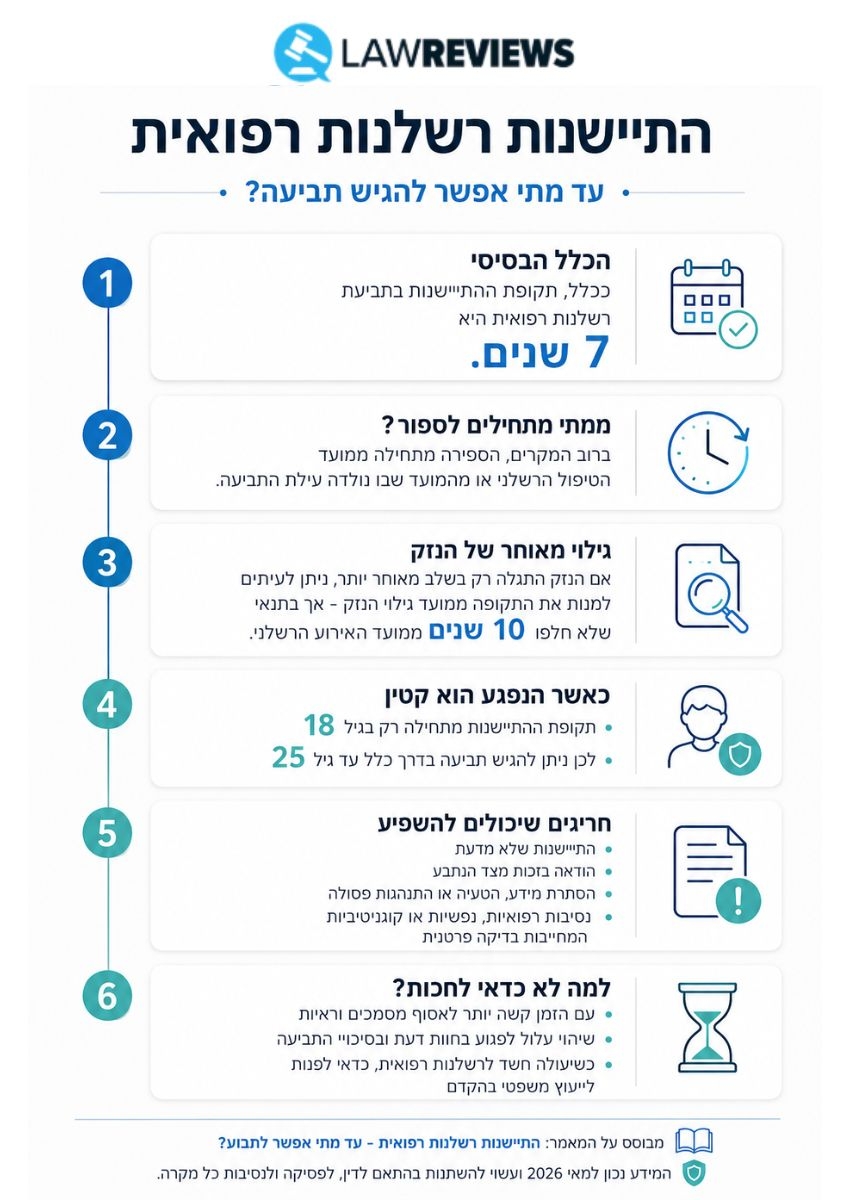
As a general rule, the statute of limitations for filing a lawsuit due to medical malpractice is set by law at 7 years. However, the "statute of limitations race" sometimes begins only upon discovery of the damage, and not necessarily on the date the medical treatment was provided. When minors are involved, the law grants a significant extension, allowing the lawsuit to be filed until they reach the age of 25.
Table of Contents:
- What is the statute of limitations in medical malpractice?
- Filing a medical malpractice claim late
- Unknowing discovery exception in medical malpractice
- Medical malpractice statute of limitations for minors
- Statute of limitations in case of a medical, mental, or cognitive condition of the injured party
- What stops the statute of limitations clock?
What is the statute of limitations in medical malpractice?
- What is the significance of the statute of limitations in a medical malpractice claim?
The Statute of Limitations Law (1958) establishes a fixed timeframe in the law during which a civil wrong can be sued over. If a claim is filed after the legally mandated date, the lawsuit is subject to summary dismissal by the court.
- Within how much time can a medical malpractice claim be filed?
The standard statute of limitations for a medical malpractice lawsuit is 7 years. In the case of minors (under the age of 18), the limitation period begins counting from the day they become legal adults.
- From when do they start counting the limitation period?
The limitation period in medical malpractice lawsuits begins counting from the day the cause of action accrued—meaning, the moment the negligent treatment that caused the damage was administered.
- Do they count 7 years from the day of treatment, from the day the damage was discovered, or from the time of diagnosis?
The limitation period is counted from the day of the treatment that led to the damage. In cases where the damage was discovered only at a later stage, meaning not at the time the treatment was received, the claim will lapse within 7 years from the day the damage was discovered, provided that 10 years have not yet passed since the negligent treatment was administered.
- Is it always impossible to sue once 7 years have passed?
There are several exceptions to the limitation period: in the case of minors injured by negligent treatment, the limitation period is counted from the date the minor reaches adulthood (age 18); in cases where the damage was discovered at a later stage (after the negligent event), the limitation period can be determined from the date of the damage (provided 10 years have not passed since the event); and in cases of people with disabilities, the limitation period may be longer.
Medical Malpractice Limitation After 7 Years - Can You Still Sue?
- What is the difference between "7 years have passed" and "the claim is time-barred"?
The difference is significant, as even if 7 years have elapsed, it does not automatically mean the lawsuit is time-barred. One must factor in how the 7 years are calculated (from when they are counted) and the existing legal exceptions that allow filing a medical malpractice claim even after 7 years have passed.
- In which cases is it still advisable to check the possibility of filing a claim?
In cases where medical malpractice caused damage to a minor, or when the damage to the patient was discovered late, it is highly recommended to check the possibility of filing a lawsuit, even if 7 years have passed since the negligent event occurred.
- What should be done if there is a fear that the claim is about to expire?
As a rule, in medical malpractice claims, it is best to act immediately when a suspicion arises that the treatment or diagnosis was negligent. Medical malpractice lawsuits are complex actions that require expert opinions, proving damage, and establishing the link between the negligent event and the damage. Therefore, and especially when there is concern that the claim is about to expire, you should immediately seek appropriate legal counsel to examine the option of filing a lawsuit.
Filing a Medical Malpractice Claim Late
- Can the court dismiss a claim without discussing the damage itself?
If the lawsuit is time-barred, it will usually be summarily dismissed by the court without discussing the damage itself. Despite this, there are exceptional cases where the lawsuit can be filed even if the limitation period has passed, provided there are circumstances that justify it, such as intentional concealment of information by the medical entity.
- What is the difference between a time-barred claim and a claim that is difficult to prove?
A time-barred claim is one that does not comply legally with the allotted timeframe for its submission—in medical malpractice cases, this means 7 years from the date of the negligent event. A claim that is difficult to prove is one where there is a challenge in presenting the link between the negligent event and the damage caused to the patient—meaning its success under tort law proof standards is uncertain.
Late Discovery of Medical Damage
- What happens if the damage was discovered only several years after the treatment?
In cases where the damage to the patient was discovered only several years after the medical treatment, the negligence period will be calculated from the date the damage was discovered. According to Section 89(2) of the Torts Ordinance, this claim can be filed on the condition that 10 years have not yet passed from the date of the negligent event that led to the damage.
- Does the date the damage was discovered change the limitation period?
The date the damage was discovered absolutely alters the limitation period. There are many cases where damage is discovered long after the negligent event. In these cases, a medical malpractice claim can be filed even if 7 years have passed since the event occurred. The limitation period in these cases is counted from the date the damage was discovered, provided 10 years have not passed since the day of the negligent event.
- What is the difference between discovering the damage and discovering the link to the medical treatment?
To prove a malpractice claim, one must prove negligent medical treatment, damage caused, and the causal link between the two. Discovering the damage is the moment the patient finds out that some damage was caused to them, but this does not indicate that the damage is linked to any specific medical treatment. Conversely, discovering the causal link to the medical treatment—meaning that the damage was caused as a result of the treatment—is what can generate the cause of action for a medical malpractice lawsuit. Essentially, the limitation period in medical malpractice claims is counted from the day of treatment, but in cases where the discovery of the damage was late because the damage was hidden from view, the limitation period will be counted from the date the damage was discovered.
- What documents can help prove that the damage was discovered at a late stage?
The patient's medical file (medical record) can indicate the link between the medical treatment and the damage, even if the damage was discovered at a later stage. A professional medical expert opinion can also attest that the damage was discovered late.
Unknowing Discovery Exception in Medical Malpractice
- What is the unknowing discovery exception?
The unknowing discovery exception stipulates that if the facts constituting the cause of action were hidden from the patient for reasons beyond their control, and which they could not have prevented even with reasonable care, the limitation period will begin on the day these facts became known to the patient.
- When can it be claimed that the patient did not know the facts underlying the lawsuit?
This can be claimed when the patient did not know, and could not have known in real time, that damage had been caused to them or that the damage was caused to them as a result of medical negligence.
- What needs to be proven to claim the unknowing discovery exception?
In cases involving the unknowing discovery exception, the plaintiff must prove that the damage (or the negligent event) was discovered late and that it was impossible to discover it earlier. In other words, the burden of proof is on the plaintiff, not the defendant.
- Is every case where the patient did not understand the significance of the damage considered an exception to the statute of limitations?
Not every case where a patient did not understand the significance of the damage is considered an exception to the statute of limitations. This is a complex legal issue that depends on the specific circumstances and the "reasonable person" test. Section 8 of the Statute of Limitations Law formulates this as: "which they could not have prevented even with reasonable care."
Additional Exceptions to the Statute of Limitations - Admission of Right, Deception, or Improper Conduct by the Defendant
- Can an admission of liability by the medical entity affect the statute of limitations?
According to Section 9 of the Statute of Limitations Law, if the defendant (the medical entity) admits in writing or before the court, either within or after the limitation period, to the patient's right to compensation, the limitation period will begin counting anew from the date of the admission.
- Does the concealment of information by a hospital or doctor alter the calculation of time?
The Statute of Limitations Law addresses qualifications that alter the limitation count. In cases where the medical entity acted improperly (knowingly misled the patient, exercised force against them, threatened them, or exploited their distress), including cases of knowingly concealing facts, the running of the limitation period will be suspended. In cases where facts were hidden from the patient for reasons beyond their control, the limitation period will begin from the date they discovered the facts.
- What is considered improper conduct by the defendant in the context of the statute of limitations?
The law dictates that the running of the limitation period will be suspended in cases where the defendant conducted themselves improperly. This conduct includes knowingly misleading the plaintiff, exercising force against them, threatening or exploiting their distress, and also knowingly concealing information necessary for the lawsuit.
- Why do such exceptions require a specific individual legal examination?
These exceptions to the Statute of Limitations Law are based on the specific circumstances of the case and the "reasonable person" test. Meaning, the court will determine whether indeed, in a reasonable manner, it occurred due to reasons beyond the plaintiff's control and which they could not have prevented even with reasonable care.
Delay (Laches) in a Medical Malpractice Claim - Why You Shouldn't Wait for the Last Minute?
- What is the difference between the statute of limitations and delay (laches)?
The statute of limitations defines (technically) the timeframe within which a malpractice claim can be filed. In contrast, delay (laches) is an equitable defense argument presented by the defense (the sued party) stating that the plaintiff filed late (or argued late) even if within the limitation period. This is a substantive defense argument claiming that the delay in filing the lawsuit, or in raising certain arguments, caused evidentiary damage (for example, lost documents, witnesses who do not remember what occurred, etc.).
- Can a claim filed before the end of the limitation period still be harmed due to delay?
Yes, a medical malpractice claim can still be harmed if a significant delay occurs in its management after its submission, even if filed before the end of the limitation period. Although filing the lawsuit technically "stops" the standard limitation clock, inaction or further delays on the plaintiff's part can lead to its dismissal.
- How can delaying harm the collection of evidence and the medical expert opinion?
As time passes from the date of the negligent event, the process of collecting medical materials, testimonies, and relevant documents becomes increasingly difficult and complex. It must be remembered that to prove a malpractice claim, one must establish the negligent event, the damage caused, and the link between the two. Any delay by the plaintiff in collecting materials harms a more authentic and accurate recording of the events and their outcomes. The medical expert opinion, which relies on the medical file, is also affected by the patient's delay.
- Can a delay in contacting a lawyer weaken the chances of the lawsuit?
Generally, the moment a fear of negligent treatment arises, it is advisable and important to seek legal counsel as soon as possible. Delaying contacting a lawyer can harm the chances of the lawsuit being accepted. The lawsuit relies on the medical file, on expert opinions, and other evidence, and as time passes from the date of the event, it becomes harder to collect and document the occurrences.
Medical Malpractice Statute of Limitations for Minors
- How is the statute of limitations calculated when the injured party is a minor?
When the injured party is a minor, the limitation count does not begin from the date of the negligent event, but from the date they reach adulthood (age 18). This means that a minor aged 12 injured by negligent treatment can file a malpractice claim regarding it until the age of 25.
- Can a minor file a claim after the age of 18?
A minor can file a claim after the age of 18. In medical malpractice cases, the limitation count begins only at this age, and they can sue over it until they reach 25.
- What happens if the parents did not act in time?
Even if the parents did not sue on behalf of the minor within 7 years of the negligent event, a malpractice claim can still be filed later, after the minor turns 18. Nevertheless, it is important to contact a lawyer as soon as possible (even before the minor becomes an adult), to collect and document the materials required for the lawsuit, in order to strengthen its chances of success.
Statute of Limitations in a Claim by the Parents vs. a Claim by the Child
- Is the limitation period for the parents and for the child identical?
No, the limitation period is not identical. The limitation period for the parents stands at 7 years, and if they have independent causes of action (damage and losses caused to them), they must sue within the legally mandated time. For minors, a claim can be filed later, and the limitation period is counted from when they reach the age of 18.
- In which cases do parents have an independent cause of action?
In cases of medical malpractice occurring during pregnancy or birth, where consequently the child is born with a defect or disability, the parents have an independent cause of action. This claim, which is part of a "wrongful life" or "wrongful birth" context, focuses on the damage caused to the parents themselves.
- Can a claim by the parents expire before the child's claim?
A claim by the parents can expire before the child's claim, because the limitation count for them begins from the date of the event (unlike a minor, where the count begins from the day they reach age 18).
Statute of Limitations in Case of a Medical, Mental, or Cognitive Condition of the Injured Party
- What happens if the injured party was unable to take care of their affairs?
When dealing with an injured party who was unable to take care of their affairs due to a mental or intellectual disability (temporary or permanent), the running of the statute of limitations does not begin as long as a guardian has not been appointed for them. Only after a guardian is appointed, and only after the facts constituting the cause of action are brought before them, will the count toward expiration begin.
- Can a mental, intellectual, or cognitive condition affect the limitation period?
Absolutely. A mental, intellectual, or cognitive condition affects the limitation period, and as long as a guardian has not been appointed for the patient, the counting of years toward expiration stops.
- What is the significance of appointing a guardian regarding the statute of limitations?
The appointment of a guardian regarding the statute of limitations relates to cases where the injured party has a mental or intellectual disability. As long as a guardian is not appointed, there is no limitation running, and only after the appointment and after the facts are brought before them will the count toward expiration begin.
- What documents can prove that the injured party was unfit to act in time?
Many medical documents can prove that the injured party was unfit to act. For example, medical documents attesting to a lack of cognitive or mental competence, such as a psychiatric/geriatric opinion, documentation of psychiatric hospitalizations, neurological assessments, and legal documents (such as decisions of the National Insurance Institute's medical committees or an activated continuous power of attorney).
Medical Malpractice Limitation at Birth
- From when do they start counting the statute of limitations in the case of medical malpractice at birth?
The question of the statute of limitations varies depending on who the injured party is—the mother or the newborn. The limitation period for the newborn begins counting upon reaching age 18. In a claim by the parents (the mother/spouse), the limitation period is 7 years from the day of birth, and up to 10 years (if the damage was discovered at a later stage).
- What happens if the developmental damage was discovered only a few years after the birth?
In the case of children injured at birth, the limitation period begins counting from when they reach the age of 18. In highly exceptional cases, it may be possible to request an extension of the limitation period even beyond that, if the damage was hidden and could not be discovered in a reasonable manner. In a case where the mother discovered the damage at a later stage, the limitation period will stand at up to 10 years from the day of the event.
Medical Malpractice Limitation in Pregnancy
- From when do they start counting the statute of limitations in the case of negligent pregnancy follow-up?
Until the Hammer ruling, the statute of limitations for negligence in pregnancy and birth was 25 years from the date of birth. The Hammer ruling created a shift in the limitation date. Now, the limitation time for a medical malpractice lawsuit in pregnancy stands at 7 years from the day of birth if the damage was discovered immediately, and 10 years if the damage became clear later.
- Can a failure to refer for tests in pregnancy establish a cause of action?
Yes, a failure to refer for tests can establish a cause of action. It is the duty of the medical staff to refer the pregnant woman for accepted tests (such as systems review, nuchal translucency, genetic testing, etc.) in accordance with the accepted protocol and according to the characteristics of the woman and her partner.
- What happens if the parents discovered only after the birth that the problem could have been diagnosed earlier?
If the parents discovered after the birth a defect or medical problem in the fetus that could have been diagnosed at an earlier stage, they have the right to file a medical malpractice claim under the cause of action known as "wrongful birth." The meaning of this claim is that the medical staff was negligent in its duty and thereby deprived the couple of their right to autonomy to make the decision whether to continue the pregnancy or terminate it. In these cases, the limitation period for the parents is 7 years from the day of birth.
Medical Malpractice Limitation in Surgery
- From when do they start counting the statute of limitations in the case of surgery?
According to the law, the limitation in a surgery case begins counting from the date of the event itself—meaning from the day of the surgery. In cases where the damage was not discovered on the date of the event, the limitation begins from the day the patient discovered the damage (up to 10 years from the day of surgery).
- Is a complication discovered after surgery considered medical malpractice immediately?
Not every complication after surgery is considered medical malpractice. Surgeries involve risks, and there is a distinction between a "recognized complication" and medical malpractice. Medical malpractice can be claimed when the complication arose from a deviation from the accepted medical standard.
- Do repeat surgery or follow-up treatments affect the limitation date?
The limitation date will not change automatically. The mere existence of repeat surgeries or continuous treatments does not turn the event into a "continuous wrong." The limitation clock regarding the original surgery will run from the day of the surgery, unless it is proven that the medical staff continued to be negligent in an active and separate manner.
- What documents is it important to collect in case of suspected medical malpractice in surgery?
All medical documentation related to the treatment must be collected from the doctor or the medical institution where the plaintiff was treated. According to the Patient Rights Law, the medical institution must document the patient in writing, and the patient has the right to receive a copy of the record. The record includes the medical file, hospitalization sheet, anesthesia records, and more.
Medical Malpractice Limitation in Illness Diagnosis
- From when do they start counting the statute of limitations in the case of a late diagnosis?
A case of late diagnosis is considered an exception in the Statute of Limitations Law. In this case, the limitation begins counting from the day the damage was discovered or from the day the patient should have discovered the damage.
- What happens if the patient turned repeatedly to the doctor but the diagnosis was given late?
In a case where the diagnosis was given late, despite the patient's visits, the court will examine whether the doctor was negligent in their duty through the reasonable doctor test, and whether the delay caused actual damage to the patient and what it is.
- How do you prove that the illness could have been diagnosed earlier?
To prove that the illness could have been diagnosed earlier, a medical expert opinion must be obtained from a specialist who reviews all medical documents. A medical expert will be able to examine whether the treating doctor deviated from the reasonable standard of care.
- What happens if previous tests were not interpreted correctly?
Incorrect interpretation of previous tests can lead to severe medical consequences for the patient. To file a medical malpractice claim, a causal link must be proven between the negligent event and the damage caused to the patient. When dealing with a sequence of tests that were all interpreted incorrectly, each interpretation represents a separate cause of action.
Medical Malpractice Limitation in Drug Treatment
- From when do they start counting the statute of limitations in the case of damage from a drug?
In the case of damage from a drug, the limitation period begins counting only after the discovery of the damage (and not with the start of taking the drug) and up to 10 years from the day of the damage event.
- Can prescribing an unsuitable drug or a dangerous drug combination be considered medical malpractice?
Prescribing an unsuitable drug or a dangerous drug combination can establish grounds for a medical malpractice lawsuit. For this claim to be accepted, it must be proven that the doctor/pharmacist/medical staff deviated from the reasonable medical standard.
- Does failing to provide an explanation of risks in drug treatment affect the claim?
Failing to provide an explanation of the risks in drug treatment represents a central ground for filing a medical malpractice claim called "breach of informed consent duty." According to the law, a doctor has a legal obligation to provide the patient with all the necessary information so that they can formulate the decision whether to take the drug or not.
Medical Malpractice Limitation in Dentistry
- Is a medical malpractice claim against a dentist subject to the same statute of limitations rules?
Yes, the limitation period for a medical malpractice claim against a dentist is counted from the date of the negligent event.
- What happens if the damage is discovered only after years, for example in implants or root canal treatments?
In dental treatments, it often happens that the damage is discovered only after a certain period. In these cases, the limitation period will begin counting from the date the damage was discovered and up to 10 years from the occurrence of the event.
- Does ongoing dental treatment affect the calculation of the statute of limitations?
In cases where the patient is undergoing ongoing treatment to correct the previous damage, this does not suspend the running of the statute of limitations regarding the original failure.
What stops the statute of limitations clock?
- Does contacting a lawyer stop the statute of limitations?
Contacting a lawyer does not stop the statute of limitations. A lawyer specializing in medical malpractice claims can assist the patient in formulating the claim and acting within the time limits of the limitation period, or try to extend the limitation period in exceptional cases, in accordance with the law.
- Does sending a letter to a hospital stop the statute of limitations?
Sending a letter does not stop the limitation period.
- Does a complaint to the Ministry of Health or a request for documents stop the limitation period?
A complaint to the Ministry of Health or a request for documents does not stop the limitation period.
- What is the correct legal way to protect rights before expiration?
In any suspicion of receiving negligent medical treatment, it is best to contact a lawyer specializing in medical malpractice claims as soon as possible. The lawyer will know how to direct the patient on how to proceed at the legal level, collect the necessary documentation, obtain the professional expert opinion, and file a claim by the required date.
Time of Handling the Claim - Can the Proceeding Continue Even After the Limitation Period?
- Is it enough to file the claim before the end of the limitation period?
Formally, yes. Practically, there is a risk in doing so as malpractice claims are complex and their formulation requires extensive preparation.
- What happens if the legal proceeding lasts years after the claim is filed?
Once a torts claim is filed, the limitation clock stops completely. Even if the trial lasts an entire decade, it has absolutely no effect on the "statute of limitations" of the claim.
- What happens if a claim was dismissed and needs to be refiled?
Upon filing the claim, the limitation clock stopped. According to Section 15 of the Statute of Limitations Law, if the court decides to dismiss the claim and it was not adjudicated, then the period between filing the claim and its dismissal is not counted in the tally of limitation years. The law further dictates that if after deducting this period, there is a very short time left for refiling, an extension of one year will be granted.
Summary
The information appearing in this article is intended to provide general knowledge only and does not constitute legal advice, a legal opinion, or a substitute for consulting with a lawyer experienced and knowledgeable in medical malpractice laws.
Articles in Medical malpractice - surgery

Medical Malpractice in Surgery: Guide to Rights, Proving Damage, and Stages of Filing a Compensation Claim
Did you undergo a surgery that went wrong and caused damage? Learn what surgical medical malpractice is, how to prove a failure in surgery, when and how to file a lawsuit, and how to know if you are entitled to compensation.
LawReviews

Medical Malpractice Claim: A Practical Guide, Step by Step
A practical legal guide on medical malpractice claims: when you can sue, how to prove a causal link to the damage, and what the potential rights of the injured parties are.
LawReviews

Medical Malpractice in Diagnosis
A guide to medical malpractice in diagnosis: when a misdiagnosis or delayed diagnosis may justify a claim, what damages are evaluated, and what the patient's rights are.
LawReviews

Medical Malpractice in Cesarean Section – Everything You Need to Know
Did you experience a complication during a cesarean section? It is important to know the grounds for filing a medical malpractice claim, how damages are assessed, and what the stages of compensation are. All the legal information in one place.
LawReviews

Medical Malpractice in Psychiatry: When Can You File a Lawsuit?
When might psychiatric treatment, misdiagnosis, or poor follow-up be considered medical malpractice, and what is important to know before filing a lawsuit.
LawReviews

Medical Malpractice in Dental Treatments
Medical malpractice in dental treatments can cause significant damage. In this article, we will explain when a cause of action may arise, what is important to check, and what the patient's rights are.
LawReviews
Book an Appointment
The service provided through the website is not a legal service. Documentation and sensitive information should only be given to lawyers.
About LawReviews
LawReviews is the most advanced and trusted lawyer directory in Israel, centralizing information and verified reviews on law firms. The platform, part of Israel's leading review sites group, connects clients seeking quality legal representation with recommended and top attorneys. We do this through rigorous verification technology ("wisdom of the crowd") and advanced filtering mechanisms, providing full transparency in the legal world and enabling informed decision-making.
Navigation
Contact UsAbout UsPrivacy PolicyTerms of UseAccessibility StatementLegal GuidesPhoto GalleryCreate a Lawyer ProfileLogin to Personal AreaPopular Practice Areas
Criminal LawyerEmployment LawyerFamily LawyerTraffic LawyerMedical Malpractice AttorneyNational Insurance LawyerReal Estate LawyerDebt Enforcement AttorneyTort LawyerInsolvency AttorneyWills & Inheritance LawyerCommercial LawyerDisclaimer
The information and content displayed on this site is intended to provide informative information and expressive opinion on behalf of third parties only they are not a substitute for professional legal advice and should not be relied upon as such advice. Any use of the information on the site requires examination and verification with the relevant parties. Use of the site and its contents is the sole and complete responsibility of the user
Popular Searches
DivorceTraffic AccidentsWork AccidentsPersonal InjuryPrenuptial AgreementApartment SaleApartment PurchaseDrunk DrivingSexual HarassmentWeapons License